Hast du Interesse an einem Einblick in die Wissenschaft weißt aber nicht wie?
Du kannst Fragen stellen, mehr über wissenschaftliche Forschung erfahren und verstehen, wie die Wissenschaft funktioniert. In gemeinsamen Workshops gehen wir beispielsweise den Fragen nach, was es für Wege oder berufliche Laufbahnen in der Wissenschaft gibt, wie du einen solchen Weg planen kannst und was du dabei beachten musst. Das Programm soll dir helfen, wissenschaftliche Fähigkeiten aufzubauen, damit du eigenständig in der Forschung arbeiten und bei akademischen Projekten punkten kannst. Außerdem wird dein Selbstvertrauen im Umgang mit wissenschaftlichen Kompetenzen gestärkt. Durch die persönliche Betreuung von Mentor*innen aus dem GRK erhältst du hilfreiche Unterstützung.
her.culis ist ein Förderprogramm, das vom Graduiertenkolleg 2696 getragen wird. Es spricht gezielt Bachelor-Studentinnen der Fakultäten 1, 2 und 4 an der Bergischen Universität Wuppertal an und hat sich dem Ziel verschrieben, den weiblichen wissenschaftlichen Nachwuchs frühzeitig zu fördern und zu stärken. Dieses Programm ist Teil des Engagements der Universität, den Anteil von Frauen in der Wissenschaft zu erhöhen.
Das Programm geht über einen Zeitraum von einem Jahr und startet am 01.06.2024. Es bietet den Teilnehmerinnen die Möglichkeit, an eigenen Projekten zu arbeiten und wertvolle Kontakte mit Expert*innen zu knüpfen. Darüber hinaus erhalten sie eine Vergütung für ihre Tätigkeit und haben Zugang zu interaktiven Workshops, die ihre wissenschaftliche Kompetenz weiterentwickeln.
Durch her.culis sollen junge Frauen ermutigt werden, sich frühzeitig mit der Wissenschaft auseinanderzusetzen und ihren Platz darin zu finden. Das Programm unterstützt sie dabei, ihre Fähigkeiten zu entwickeln und bietet die Möglichkeit, sich in ein Netzwerk einzubinden.
Two of our PhD students have attended the 9th Norwegian Conference on the History of Science in November 2023 (financed with funds from the Research Training Group). Jasmin Dierkes contributed to the conference with a talk “On dummies and dates: The advent of simulation-based training in medical education”. Nora Schierenbeck gave a talk “About the Classification of Personality Disorders: Transformations in the Face of Definable Landmarks or Incremental Change?”. If you are interested into their experiences in Trondheim, you can read about it in their interview.
The history of mathematics group within the GRK will be organizing a workshop on Mathematics and Its Historiography in the Long Twentieth Century: Circulations and Interactions, at the Glanzstoffhaus from March 13-15, 2024.
The workshop aims at promoting interdisciplinary collaboration and therefore proposals contributing to any aspect of the theme discussed above are welcome. Special consideration will be given to proposals from young scholars. Further information can be found on the workshop page.
The research project Big Mathematics? The Classification of Finite Simple Groups, 1950s to 1980 will be funded by the German Research Foundation. The Classification of Finite Simple Groups (CFSG), also known as the enormous theorem, is a highlight of 20th-century mathematics, both with respect to its mathematical content and to the complex process of proving the result.
In this project, Volker Remmert (Wuppertal) and Rebecca Waldecker (mathematics, MLU Halle-Wittenberg) intend to thoroughly analyze the history of the CFSG and use it as a magnifying glass to study the history of mathematics and the mathematical community in the context of the Cold War (e.g. the impact of politics on research in pure mathematics in the Cold War, namely via new possibilities of funding research in general and of mathematical research in particular, a largely unexplored territory). Further information can be found here.
On the first of October 2023, the members of the GRK 2696 “Transformations of Science and Technology since 1800” were pleased to welcome six new PhD students who will participate in the GRK graduate school program. The second cohort consists of Elife Cetintas, Tobias Grabosch, Fabienne Grimm, Linda Grohmann, Anastasiia Lazutkina and Charlotte Poller.
In order to give the new PhDs a good start to their PhD journey, the first cohort hosted a Welcome Week, which took place from 10th – 12th October 2023. The Welcome Week started with an official welcome ceremony: Spokesperson Prof. Dr. Volker Remmert opened the event with a welcome speech, followed by the presentation of the GRK concept and theoretical framework presented by the first cohort PhD students Jeremias Düring and Nora Schierenbeck, and Principal Investigator Jun.- Prof. Dania Achermann closed the event with an inspiring speech about her personal career path in academic research. The second day began with a tour of the campus Grifflenberg. There, the PhDs of the first and second cohort explored the extensive campus. During a joint lunch, there was already plenty of opportunity to exchange ideas about each other’s projects. The day ended with the inauguration lecture from Principal Investigator Prof. Anna Leuschner. On Thursday morning Sophie Charlott Ebert the head of the Equality and Diversity Unit at the University of Wuppertal, visited the new GRK members. She introduced the PhDs to the unit’s services, such as individual coaching, child care services, and the SelmaMeyerMentoring in cooperation with the University of Düsseldorf. In the afternoon the PhDs went on a city tour through Wuppertal, explored Campus Haspel and the Hardt-Anlage. The Welcome Week ended with a shared dinner and a pub crawl in the Luisenviertel in Wuppertal. The whole GRK team is very happy to welcome the six new PhD students and wish them all a great start in the GRK program.
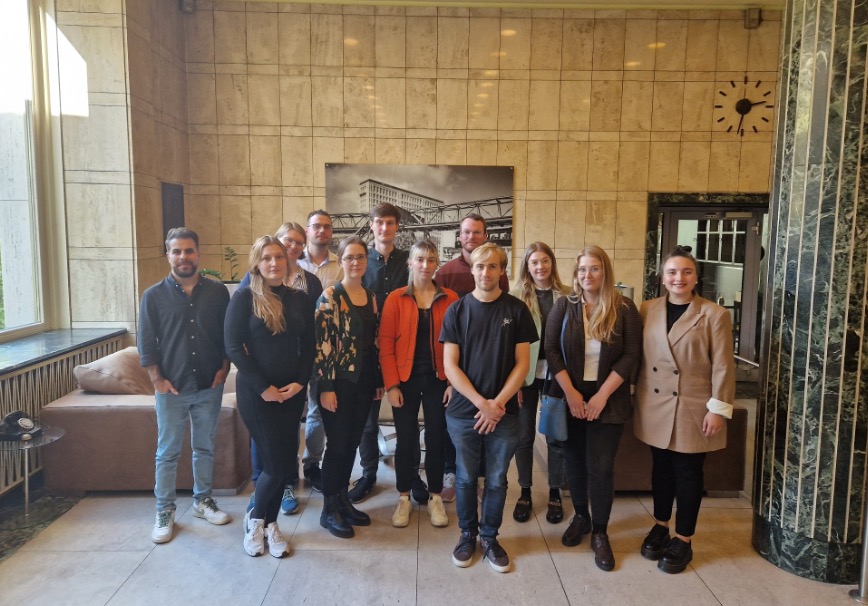
PhD students from the 1st and 2nd cohort gathered in the lobby of our office building.
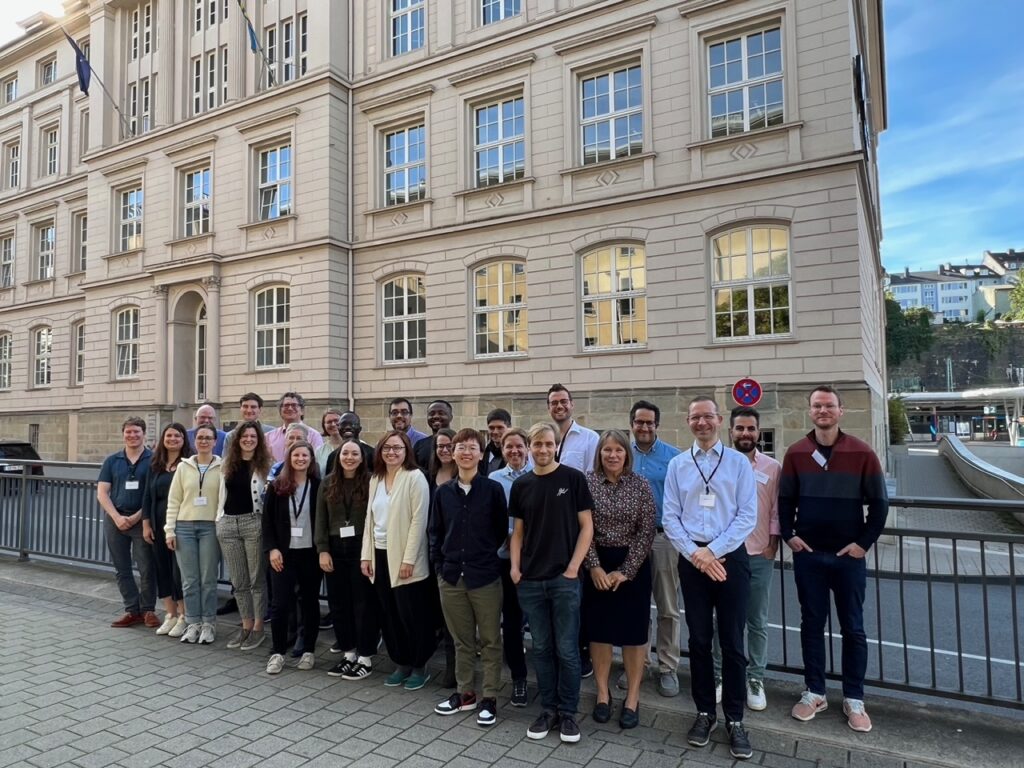
Doctoral students and renowned researchers from all over the world have come together for a summer school on the topic of “Collaboration and Interdisciplinarity in Science and Technology” in the week from 24th to 29th of September 2023. The summer school is organised by the Research Training Group in collaboration with the Summer School Series in Higher Education Research and Science Studies (HERRS). The invited scholars provided the doctoral students with insights into the complex topic of scientific collaboration and interdisciplinarity by presenting the latest theories, methods and research designs aimed at better understanding the complex web of scientific collaboration, the costs and benefits of interdisciplinary research, the competition between research fields, the institutional conditions for successful collaboration and its impact on scientific careers. The summer school offered the young researchers from the fields of history, philosophy and sociology of science the opportunity to discuss these topics with leading scientists and develop new ideas for their own projects.
Hanne Andersen is one of the currently three Mercator Fellows of the Research Training Group 2696 and will give this lecture as part of her first stay in Wuppertal. You can find more information about the topic on the respective poster and read more about her here. Hanne Andersen will also be part of the summer school in September.
This workshop is a seminar for members of the Research Training Group only. You can find more information on the respective poster. If you are interested in the topic, please contact Nina Lorbach.
This workshop is a seminar for members of the Research Training Group only. You can find more information on the respective poster. If you are interested in the topic, please contact Nina Lorbach.
March 15th is an important date for the IZWT as well as the entire Bergische Universität Wuppertal since it marks the official opening of the Research Training Group “GRK 2696 – Transformations of Science and Technology since 1800: Topics, Processes, Institutions”. Since the DFG’s creation of a Research Training Group is an important step in distinguishing Wuppertal as a research site, this celebration was more than just a formal act.
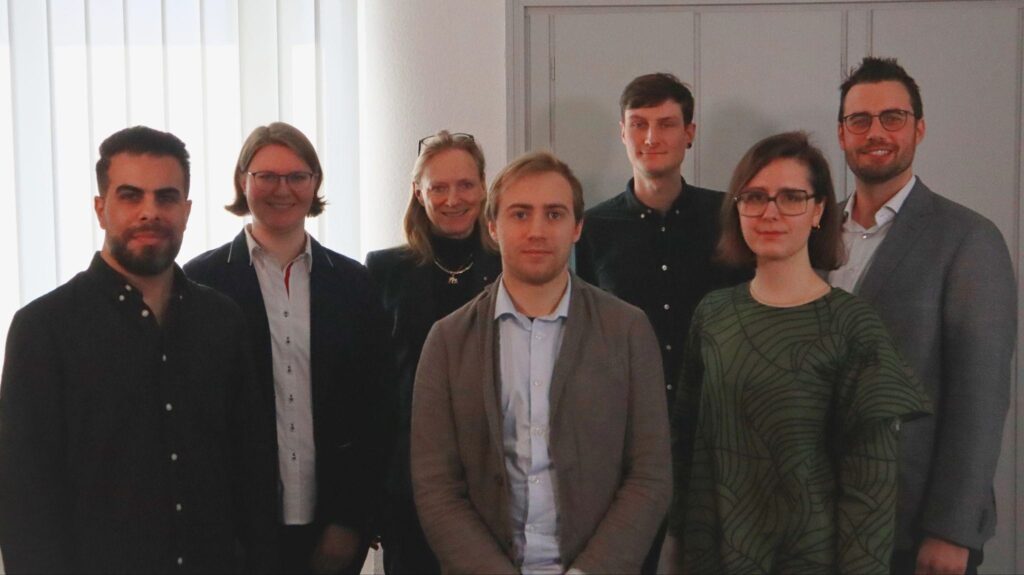
The six PhD students of the Research Training Group with the Rector of the University, Prof. Dr. Birgitta Wolff (f.l.t.r. Sarwar Ahmed, Jasmin Dierkes, Birgitta Wolff, Lucas Gautheron, Jan Nicolay, Nora Schierenbeck, Jeremias Düring)
At the event, all eyes were on the six members of the first cohort. The PhDs have been working on their projects nonstop since October 2022 and enthusiastically welcomed the opportunity to officially present their research proposals, in which historical institutionalism plays a significant role, to a large audience. It was therefore a special pleasure to welcome the Chancellor Dr. Roland Kischkel, the Vice-Rector for Research and Digital Affairs Prof. Dr. Stefan F. Kirsch, and the Rector of our University, Prof. Dr. Birgitta Wolff, to the GRK’s new building. The opening statement was entrusted to Volker Remmert, the Spokesperson of the Research Training Group. He thanked everyone involved in making the project possible. The ceremony had an almost familiar atmosphere to it and the audience was excitedly listening to the six PhD students in the front: Sarwar Ahmed, Jasmin Dierkes, Jeremias Düring, Lucas Gautheron, Jan Nicolay and Nora Schierenbeck. Almost everyone who is either involved in the Research Training Group itself or feels particularly connected to it was able to accept the invitation, resulting in a rather crowded seminar room and lively conversations afterwards.
Spokesperson of the GRK Prof. Dr. Volker Remmert giving an opening statement
After a warm welcome and an introduction to the program from Jeremias Düring, the Research Training Group’s unique characteristics were presented by Nora Schierenbeck before each PhD student outlined their doctoral topic. All coming from a different academic background, there were a lot of disciplines covered in the individual proposals. While Sarwar Ahmed´s and Lucas Gautheron´s research topics are located in Philosophy of Science with a focus on Philosophy of Physics, Jeremias Düring´s project focuses especially on the intersection of Philosophy of Science and Philosophy of Economics. Jasmin Dierkes´ thesis thematizes the professionalization in the medical field with special focus on simulations from not only a sociological, but also a historical perspective. Located in the History of science is also Jan Nicolay´s project in which he investigates research vessels as a point of contact between science, technology and politics, as well as Nora Schierenbeck´s proposal that also includes a psychological perspective and therefore can be located in the history of psychiatry.
The research community has certain noteworthy disciplinary and conceptual features including its enormous disciplinary diversity and interdisciplinarity. Collaboration between several fields and interdisciplinary discussion are strongly encouraged. However, the impact of this kind of collaboration goes beyond new research perspectives. In the long-term, it promotes the transfer of knowledge inside the entire institution, strengthening the Bergische Universität Wuppertal as a center for science. The fact that the members in the GRK come from various academic communities and geographical locations results in a diversity of perspectives. The academic freedom to pursue one’s scientific curiosity and the supportive structure of the project enable a standard of high productivity and are complements to interdisciplinarity and internationality.
Rector of the University, Prof. Dr. Birgitta Wolff reflecting on the presentation of the six PhD students and encouraging them to tackle challenges on their way
As a final word was Birgitta Wolff’s turn to address the visitors. In a rather personal speech, the rector reflected on her career and encouraged the six doctoral fellows for the challenges ahead while offering them all the support she could give. She also emphasized the advantages of a medium-sized university, which offers sufficient subject diversity for an institution such as the GRK, but does not become so confusing that the individual doctoral student runs the risk of getting lost. In particular, their contribution shows a specific form of collegiality that is not endangered by too strong hierarchies. Both correspond to the basic requirements of the Research Training Group, which aims to bring individual projects to the best possible conclusion through cooperation.
The formal part of the morning was followed by a buffet, which provided the opportunity for a closer exchange. Moreover, the future plans of the Research Training Group were discussed intensively: In September, the GRK will organize a large summer school under the leadership of Thomas Heinze to intensify interdisciplinary discussions. The two Mercator fellows, Cyrus Mody from Maastricht University and Hanne Anderson from the University of Copenhagen, will also participate in this summer school. Furthermore, the PhD students have international research visits and conferences coming up.
All in all, the start of the “GRK 2696 – Transformations of Science and Technology since 1800: Topics, Processes, Institutions” can be named successful, and there are many reasons to follow its work closely in the future.